
Databricks
As an official Databricks delivery partner, we cover the full lifecycle of the Lakehouse and Mosaic AI platform — from license sales and technical support to training.
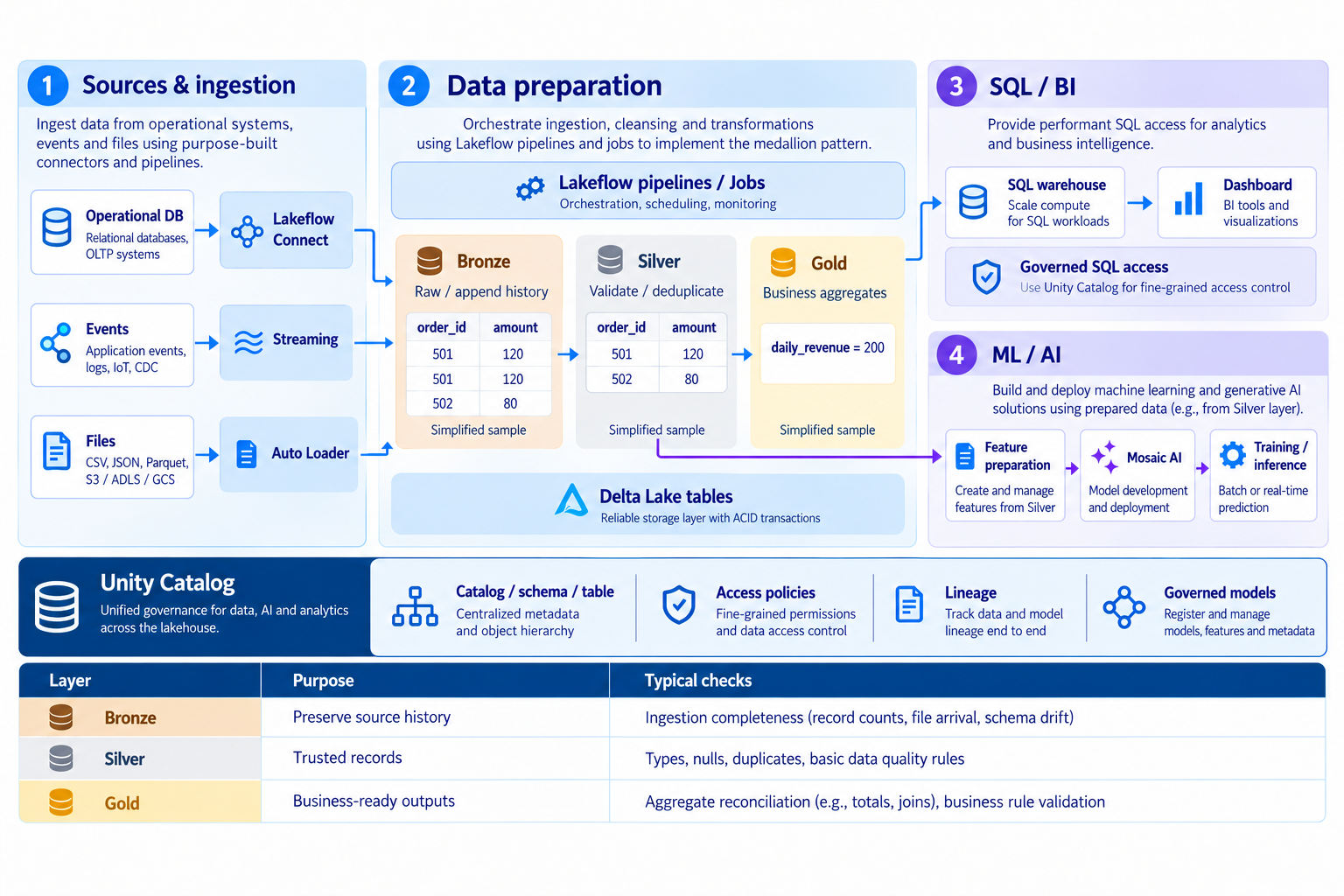
From raw data to analytics and AI
Refine data progressively and make purpose-built datasets available to analytics and AI.
Read diagram, product and service details
- 1.Ingest data
- Collect business databases, files and events with pipelines such as Lakeflow.
- 2.Bronze → Silver → Gold
- Preserve raw order events, deduplicate and validate records, then prepare business metrics such as daily revenue.
- 3.SQL and BI
- Query prepared data with Databricks SQL and connect it to dashboards and business analysis.
- 4.ML and AI
- Use suitable refined data and features in Mosaic AI. Not every AI input must pass through Gold.
Databricks Lakehouse overview
Databricks is a data and AI platform available on AWS, Azure and GCP. It connects Delta Lake data management, Unity Catalog access and lineage for supported assets, Databricks SQL analytics and Mosaic AI. Verify availability for your cloud, region and compute model.
- Delta Lake: open-format Lakehouse storage with ACID transactions
- Unity Catalog: unified governance for tables, files, models, and dashboards
- Databricks SQL and Photon: high-performance serverless query engine
- Mosaic AI: MLflow, Model Serving, Vector Search, and Agent Framework
Unity Catalog manages access and lineage for supported data and model assets. Source-system permissions are not automatically unified, and three layers are not mandatory for every workload.
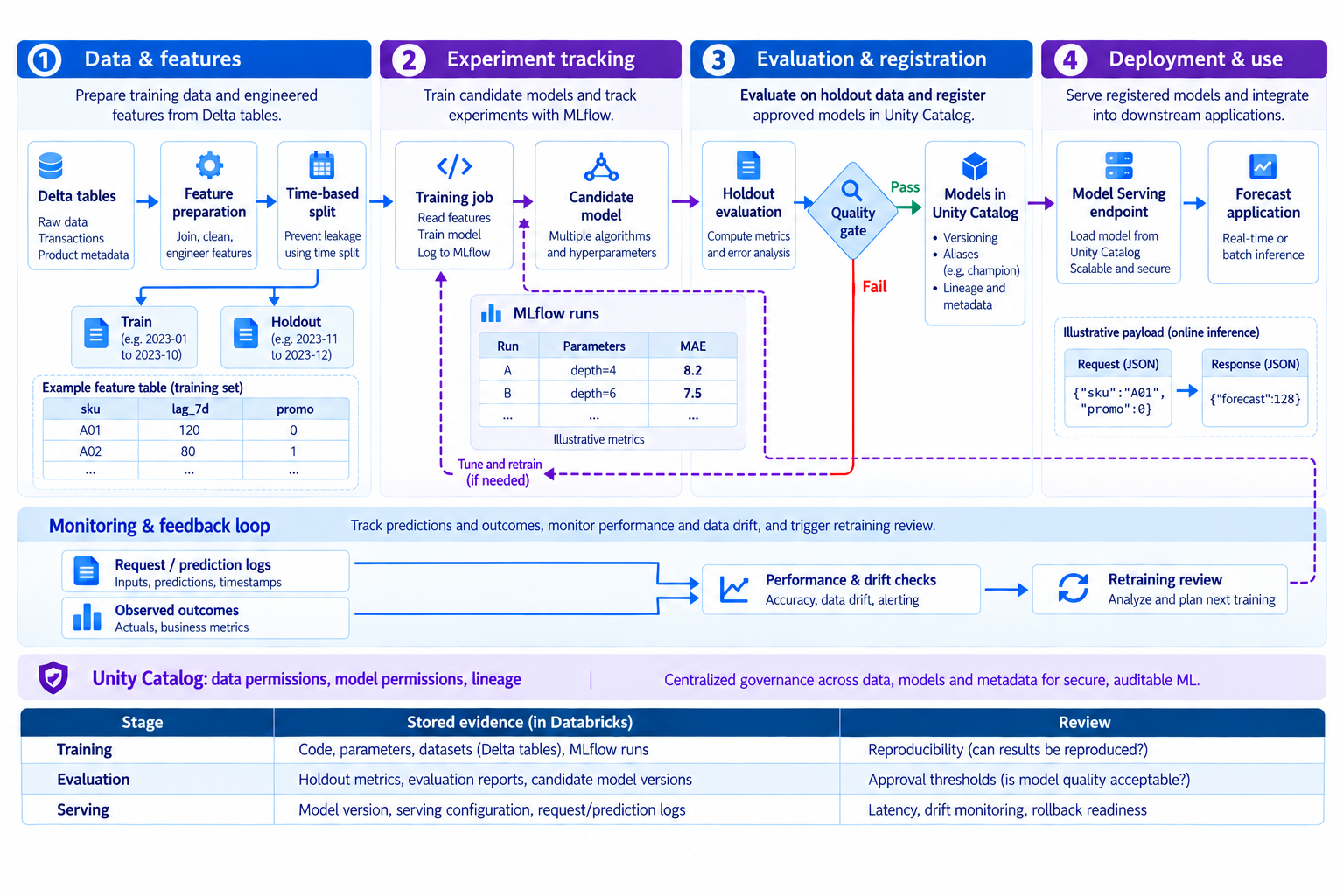
Official documentationFrom data to an operational AI service
Connect model development to evaluation, deployment and monitoring so predictions can support business workflows.
Read diagram, product and service details
- 1.Prepare data
- Prepare sales history and features for demand forecasting, with separate training and evaluation datasets.
- 2.Experiment and train
- Track experiments, model versions and results with MLflow for reproducible development.
- 3.Evaluate and register
- Validate quality against business criteria and register the model selected for deployment.
- 4.Serve and improve
- Deliver predictions with Model Serving and observe quality, latency and cost to guide improvements.
Generative AI and RAG require a separate design for document processing, retrieval and response evaluation. Classic and serverless compute differ in compute-plane location and operational responsibilities.
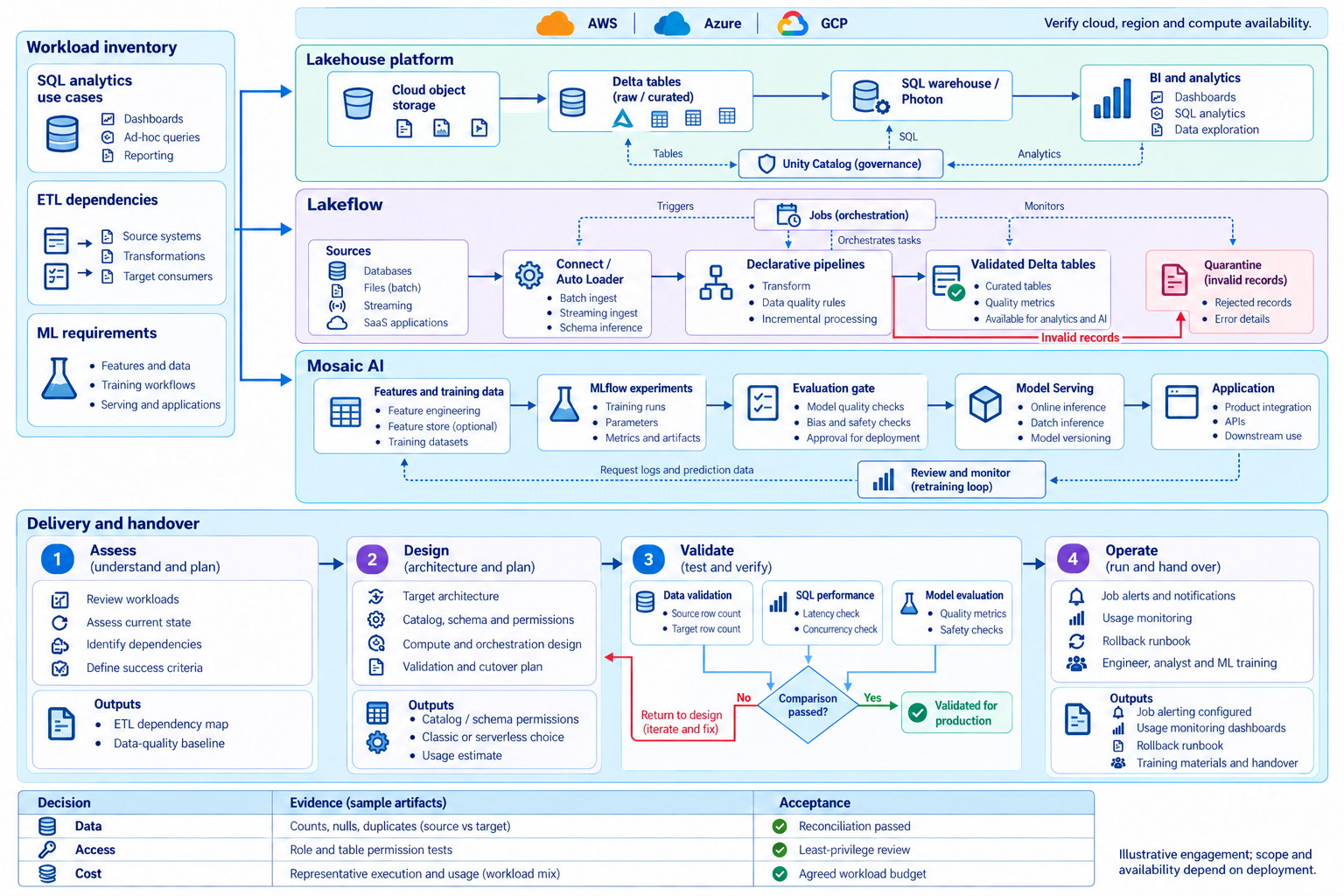
Official documentationDatabricks services from Data Dynamics
Connect product and workload choices to assessment, validation and operational handover.
Read diagram, product and service details
- 1.Assess requirements
- Inventory existing systems, data, workloads and operating constraints to define scope.
- 2.Select products and configuration
- Review products, deployment, capacity, access and procurement scope for the intended workloads.
- 3.Validate and transition
- Check correctness, performance and integration with representative workloads, acceptance criteria and recovery procedures.
- 4.Operate and train
- Prepare monitoring, runbooks, upgrade plans and team training for operational handover.
Databricks product portfolio
- Databricks Lakehouse Platform
With Delta Lake and Unity Catalog at the core, the platform delivers data engineering, analytics, BI, and ML in one place. Databricks SQL and Photon handle high-performance workloads.
Delta Lake · Unity Catalog · Databricks SQL · Photon
- Lakeflow
Build ingestion, transformation, quality checks and task execution with Lakeflow declarative pipelines and Lakeflow Jobs. Plan transitions from existing Delta Live Tables (DLT) and Workflows environments.
Lakeflow · Spark Declarative Pipelines · Lakeflow Jobs · Auto Loader
- Mosaic AI
A unified enterprise generative AI environment covering MLflow-based MLOps, Model Serving, Vector Search, the Agent Framework, DBRX, and leading Foundation Models.
MLflow · Model Serving · Vector Search · DBRX / RAG
Plan around your actual workload
Define scope using data requirements and operating conditions, not a feature checklist alone.
- Migration scope
Review ETL and warehouse dependencies, data quality and a phased migration scope.
- Access, deployment and cost
Review Unity Catalog permissions, cloud regions, classic or serverless compute and execution cost.
- Operating model
Define pipeline operations, model evaluation and deployment, monitoring and team responsibilities.
Databricks services from Data Dynamics
- License sales
As an official partner, we help procure Databricks licenses and commits — including the Lakehouse Platform and Mosaic AI — with workload-based sizing and cost optimization.
- Databricks workspace and commit contracts
- Unity Catalog and Lakehouse licensing
- Mosaic AI (Model Serving) usage planning
- Multi-cloud (AWS, Azure, GCP) adoption consulting
- Technical support
End-to-end technical support for Databricks — from solution design and implementation to migration, performance tuning, and MLOps.
- Lakehouse and Unity Catalog implementation
- Migration from existing DW and data lakes to Databricks
- Delta Live Tables and Workflows design
- Databricks SQL and Photon performance tuning
- MLOps with MLflow and Model Serving
- Generative AI (DBRX, RAG) implementation support
- Training
Hands-on Databricks training for data engineers, analysts, and ML engineers to quickly build Lakehouse and AI expertise inside your organization.
- Databricks platform administrator course
- Data engineer (DLT, Spark) courses
- Databricks SQL and analyst courses
- MLflow and Mosaic AI hands-on courses
- Generative AI and RAG workshops
Illustrative adoption workflow. Confirm product/version availability, acceptance criteria and service scope for your environment and contract.