
MinIO
As a MinIO partner, Data Dynamics supports S3-compatible object storage adoption for enterprise data and AI workloads.
MinIO AIStor object storage
MinIO AIStor provides object storage through S3-compatible APIs. Store documents, images, logs, analytical datasets and model artifacts on infrastructure you manage, and connect them to processing engines, AI pipelines and business applications. Data Dynamics helps define the configuration, delivery and operating support appropriate to your environment.
- Object access through S3-compatible APIs
- A shared storage foundation for analytics, AI and applications
- Erasure coding, versioning and object locking
- Protection and recovery planning with replication and retention
Shared object storage for data and AI
Store files, documents, images and analytical data through S3-compatible APIs, then use them with your engines and applications.
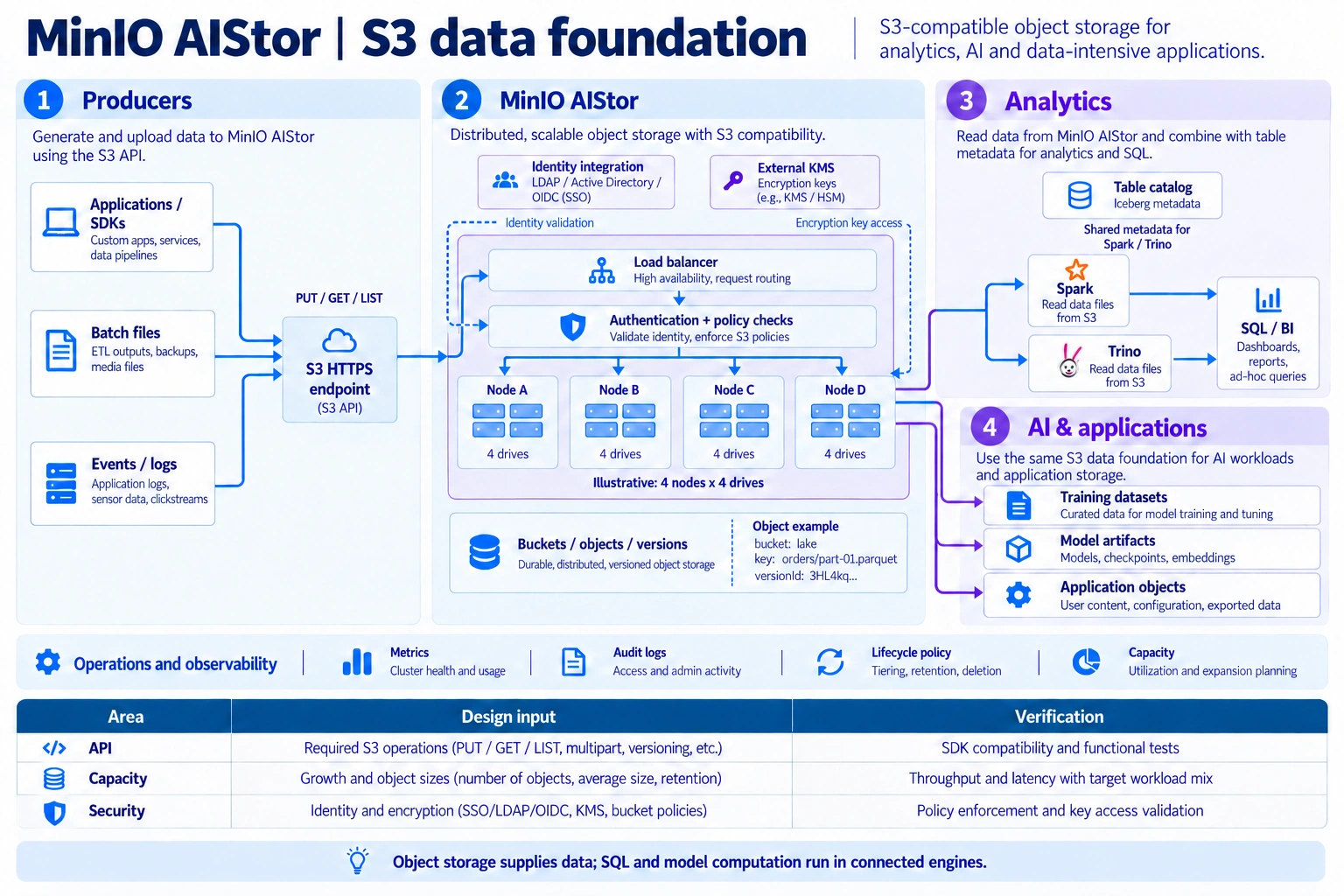
Store data
Store business files, documents, images, logs and analytical datasets as objects.
MinIO AIStor
Organize object storage access and operations around S3-compatible APIs and buckets.
Connect analytics
Validate supported connectors and table formats for engines such as Spark and Trino.
Enable AI and applications
Store training data, model artifacts and retrieval source documents for AI pipelines and business applications.
S3 compatibility does not mean identical behavior across every service and API. Validate required APIs, authentication and network paths in a PoC.
Official documentationKey use cases
Data lakes and lakehouses
Store analytical files and open-table-format data files, connected to compatible catalogs and query engines.
AI data foundation
Store training datasets, source documents, images and model artifacts for AI processing and retrieval pipelines.
Retention and backup storage
Integrate supported backup tools and configure versioning and retention. Validate recoverability with actual procedures.
Four complementary layers of data protection
Device failures, accidental changes, retention requirements and site failures call for different controls.
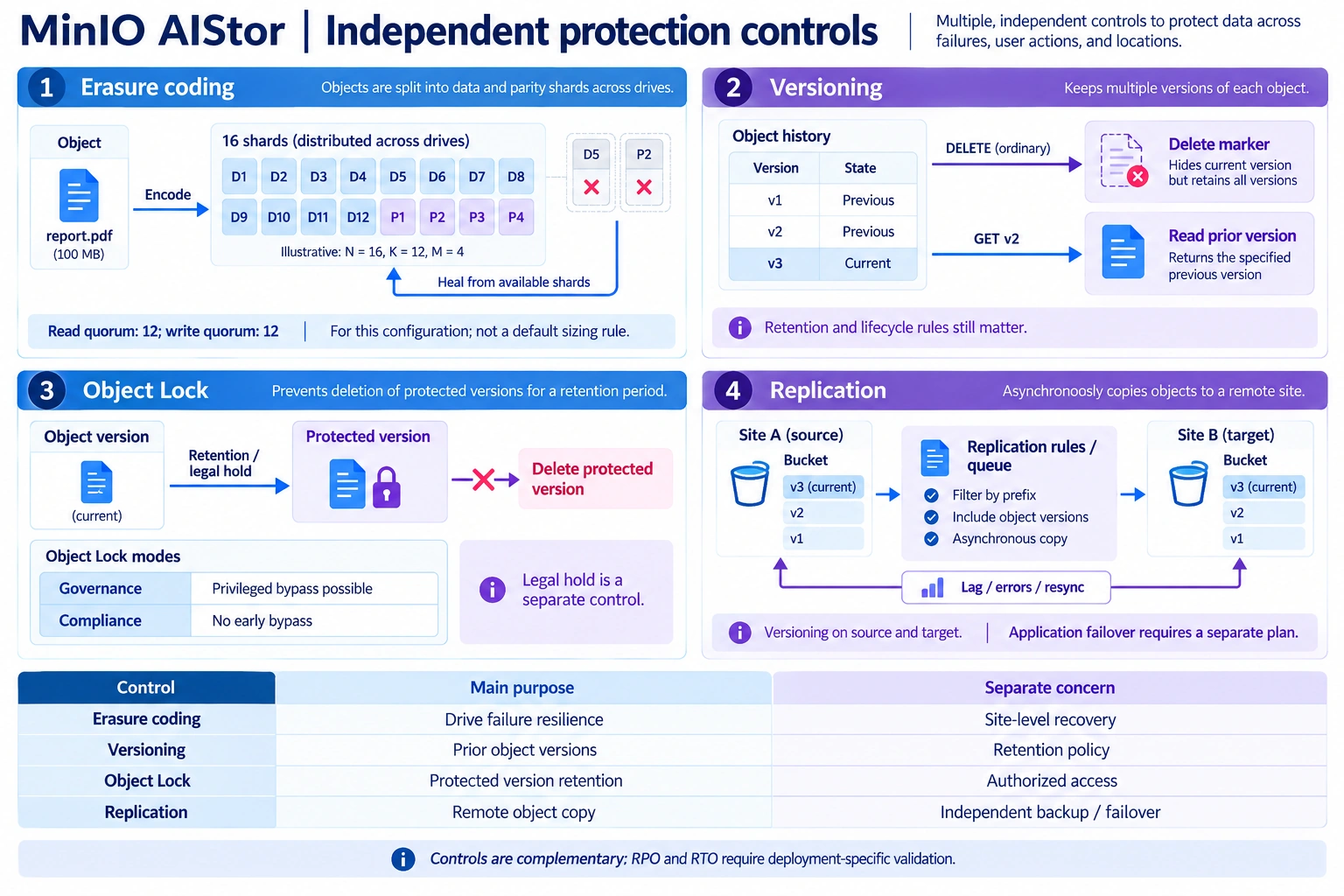
Erasure coding
Distribute data and parity shards to tolerate device failures. Tolerance depends on the deployment configuration.
Versioning
Preserve object versions in enabled buckets and recover the version you need.
Object lock
Restrict object-version deletion and modification according to retention periods and lock modes.
Replication
Replicate to separate clusters or sites, and verify recovery objectives and procedures.
Replication does not replace independent backups or recovery drills. Design RPO/RTO, delete propagation, retention, access control and recovery validation together.
Official documentationPlan around your actual workload
Define scope using data requirements and operating conditions, not a feature checklist alone.
Workload and capacity
Review object sizes and counts, read/write mix, throughput, growth and retention.
Protection and recovery
Separate the roles of failure domains, parity, versioning, locks, replication and independent backups.
Integration validation
Validate S3 API compatibility, authentication, encryption, networking and recovery procedures in a PoC.
MinIO adoption support from Data Dynamics
Adoption planning
Work with a MinIO partner to clarify product and procurement requirements.
- Workload and capacity assessment
- Product, subscription and support scope
- Configuration and cost review
Deployment and integration
Define deployment scope around your infrastructure and data-tool integration requirements.
- Storage and network planning
- S3 client and processing-engine integration
- Identity, access and encryption review
Operations and knowledge transfer
Validate protection policies and procedures, and support your internal operating capability.
- Monitoring and capacity planning
- Retention, replication and recovery validation
- Operator training scope