
Orbit Works
A multi-tenant, all-in-one business management platform that unifies your entire company operation — from sales, projects, and billing to HR, payroll, attendance, and assets.
Business modules and tenant data
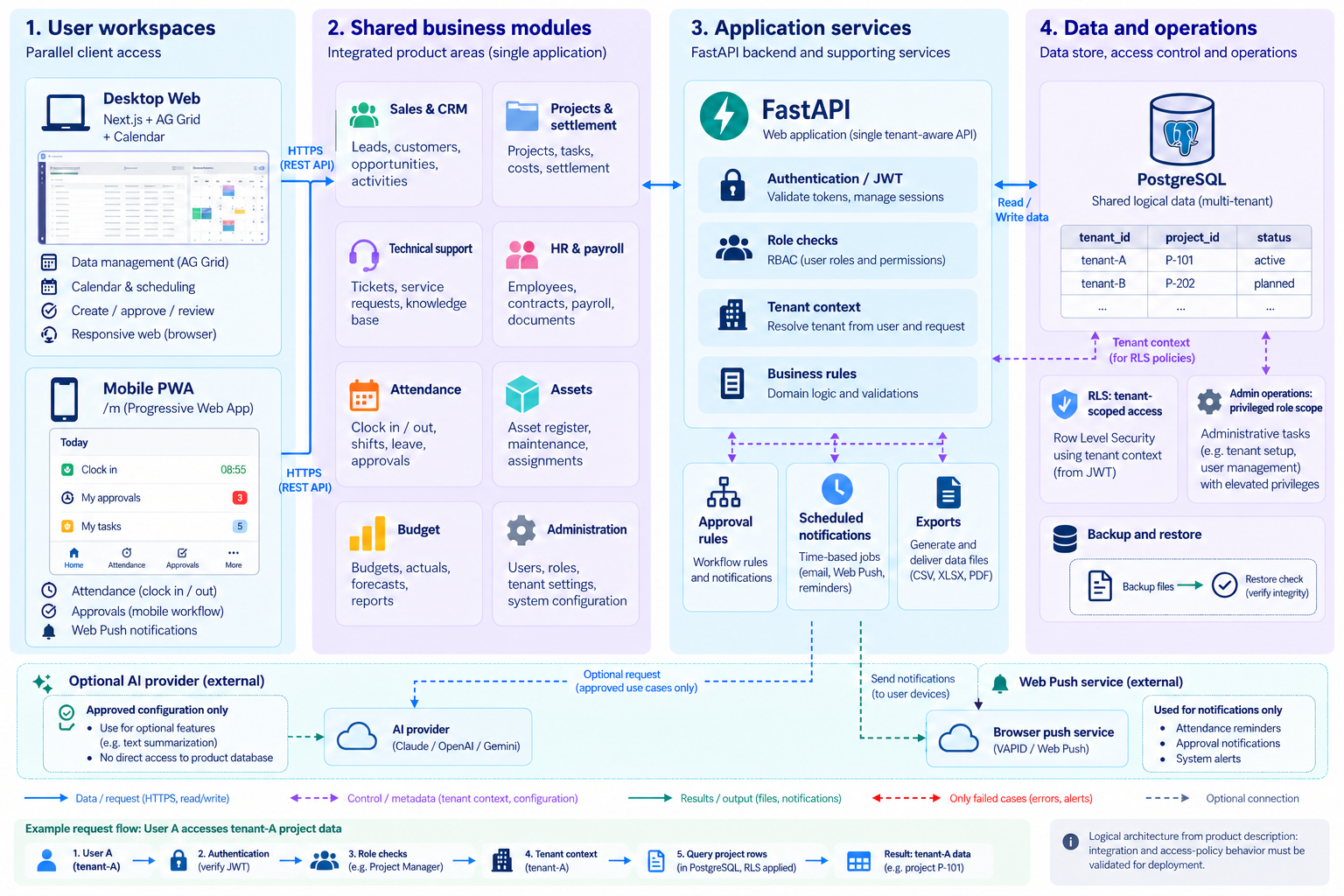
Desktop and mobile clients share business services, with role and tenant context governing data access.
- 1.User workspaces
- Desktop web and mobile PWA clients access shared APIs. Attendance, approvals and notifications are parallel user experiences.
- 2.Shared business modules
- Sales, projects, support, HR, attendance, assets, budget and administration belong to one integrated application.
- 3.Application services
- FastAPI handles authentication, role checks, tenant context and business rules alongside approvals, notifications and exports.
- 4.Data and operations
- PostgreSQL RLS uses tenant context; backup and recovery checks and privileged administration have separate operational roles.
Logical architecture based on the existing product description. Validate integration and access policies for the deployment; AI provider connections are optional.
From opportunity to project settlement
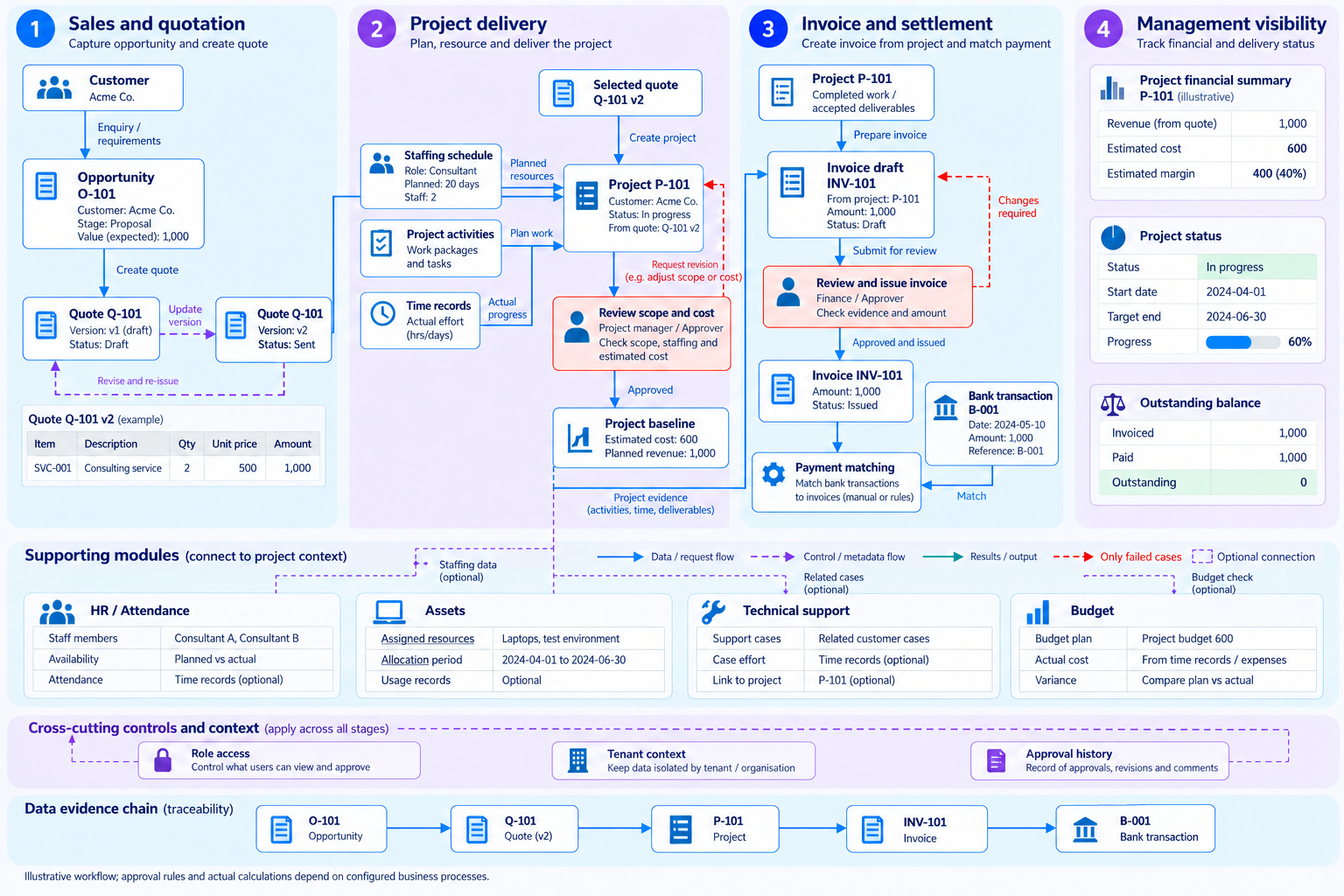
Follow the links between quotes, projects, invoices and bank transactions, including human review points.
- 1.Sales and quotation
- Create a quote from a customer opportunity and track revisions. The example uses quantity 2 × unit price 500 = quoted amount 1,000.
- 2.Project delivery
- Link the chosen quote to a project and review staffing, activities and cost. The example plan uses an estimated cost of 600.
- 3.Invoice and settlement
- Review and issue an invoice using delivery evidence, then match bank transactions. Issuing and matching are distinct business actions.
- 4.Management visibility
- Compare quoted revenue 1,000 with estimated cost 600: estimated margin 400, or 40%. Review project status and outstanding balance separately.
Amounts illustrate calculation relationships. Approval and settlement rules depend on configuration; the diagram does not imply automatic approval or creation at every step.
Eight connected business domains
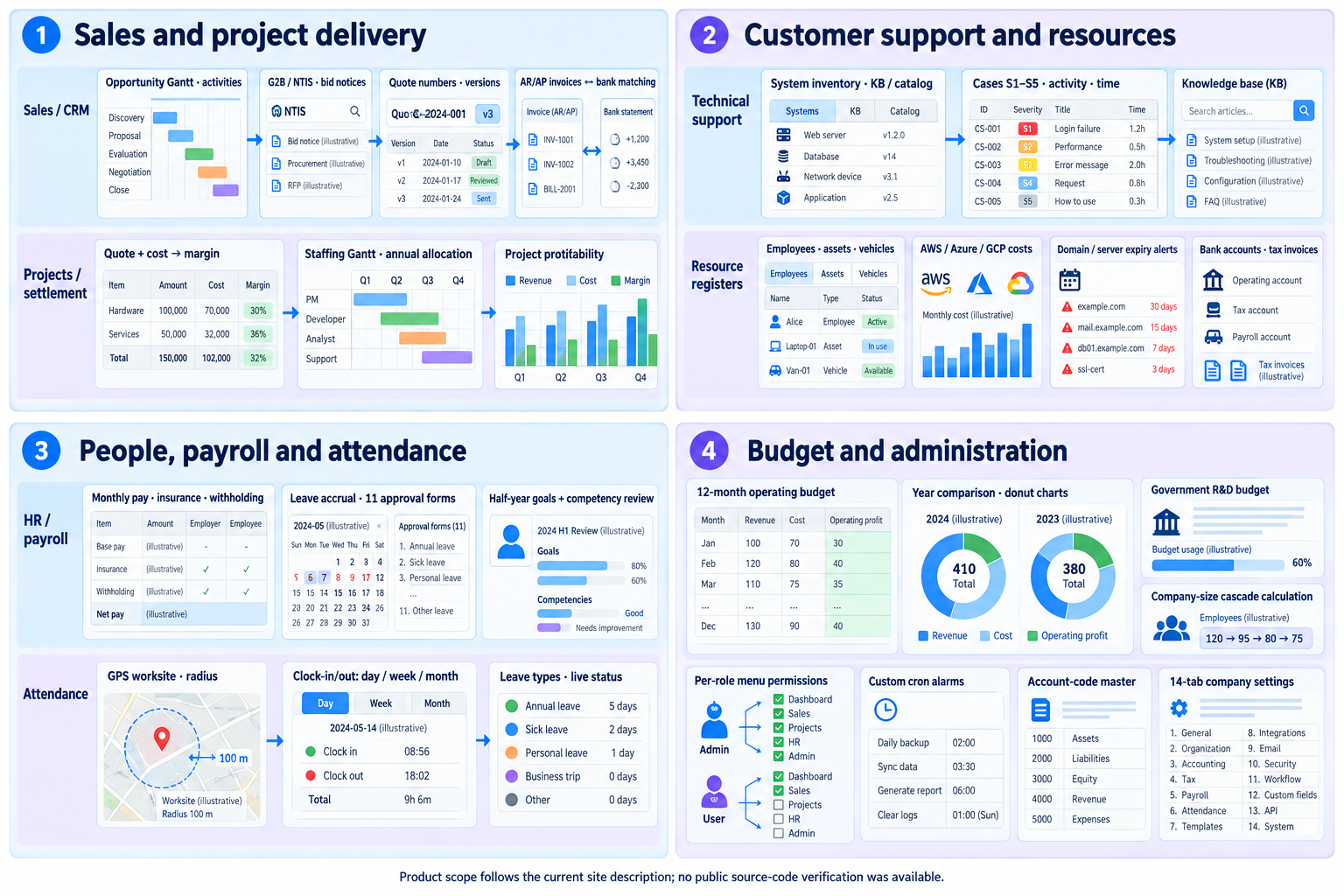
Explore the operational records and work views available in each module.
- 1.Sales and projects
- Track opportunities, quotes, settlements, staffing and profitability.
- 2.Support and resources
- Manage support cases, knowledge, assets, cloud costs and expiry dates.
- 3.People and attendance
- Connect payroll, leave, reviews and worksite attendance records.
- 4.Budget and administration
- Plan monthly budgets and configure company rules and menu access.
Product scope follows the current site description; no public source-code verification was available.
- 1.Tenant boundaries
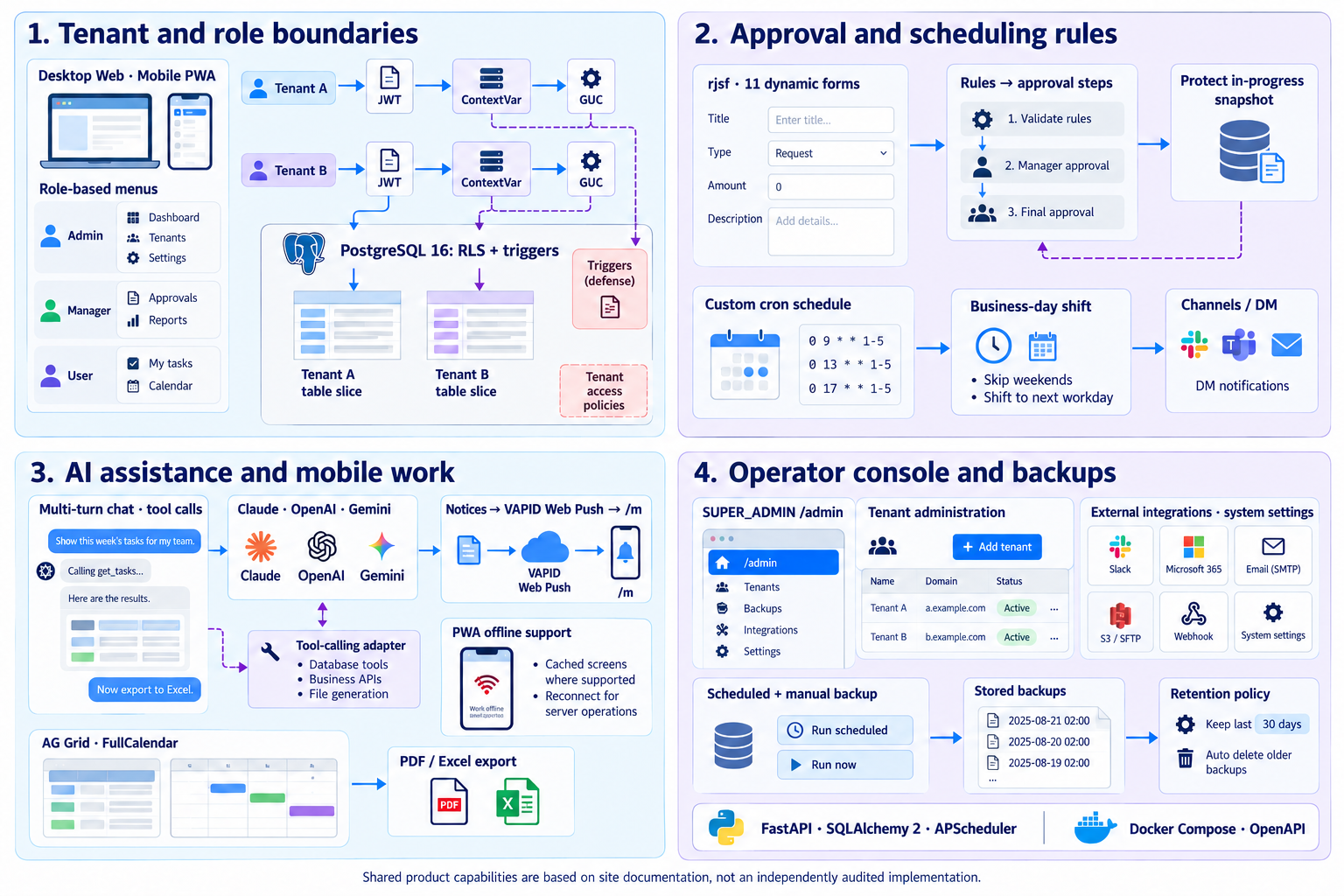
- JWT, request context and PostgreSQL policies separate tenant data.
- 2.Rules and alerts
- Dynamic forms, approval snapshots and schedules coordinate requests.
- 3.Assistance and access
- Use AI tools, mobile notifications and desktop exports.
- 4.Operator management
- Administer tenants and configure backups and retention.
Shared product capabilities are based on site documentation, not an independently audited implementation.