
Build a lakehouse
Collect database, file and API data into Iceberg tables for historical analytics and reuse.
From ingestion and storage to analytics across distributed data. A deployment and operations package combining Argus Flow, Apache Airflow 3, Starburst Enterprise and MinIO AIStor.
Combine scalable object storage with analytical table management. Separate storage from compute and use Apache Iceberg to manage schemas, snapshots and data changes.
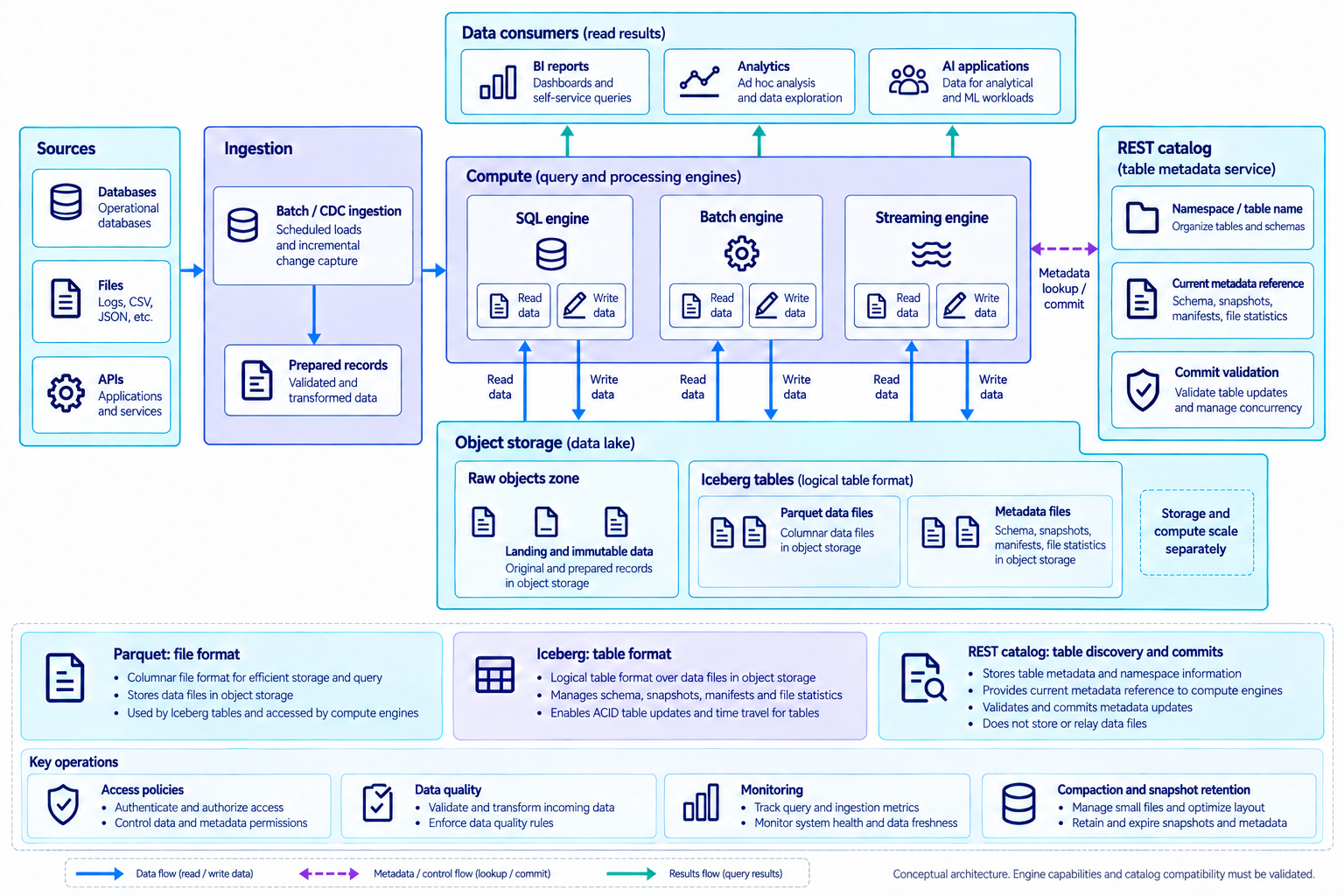
This is a conceptual architecture. SQL, batch and streaming are workload types; validate each engine’s read/write support and catalog compatibility. Size storage and compute for their respective requirements.
Read the official documentationEach layer has a distinct role in storing data and exposing a consistent table state.
| Concept | Responsibility |
|---|---|
| Parquet · file format | Stores records in columnar files. A file alone does not manage table-wide snapshots or commit state. |
| Apache Iceberg · table format | Manages a collection of data files as a table, with schema, partition layout, snapshots and file statistics. |
| REST catalog | Resolves table names to current metadata references and processes commits. Engines read data files from storage directly. |
| Object storage | Stores data and metadata files. MinIO AIStor provides the S3-compatible storage layer in this platform. |
In Open Lakehouse, Argus Flow and NiFi 2 collect and transform data, Airflow 3 coordinates tasks, Starburst performs SQL analysis and table processing, and MinIO AIStor stores files. The platform architecture below shows their connections.
Follow an append to the orders table to distinguish file storage from a snapshot commit.
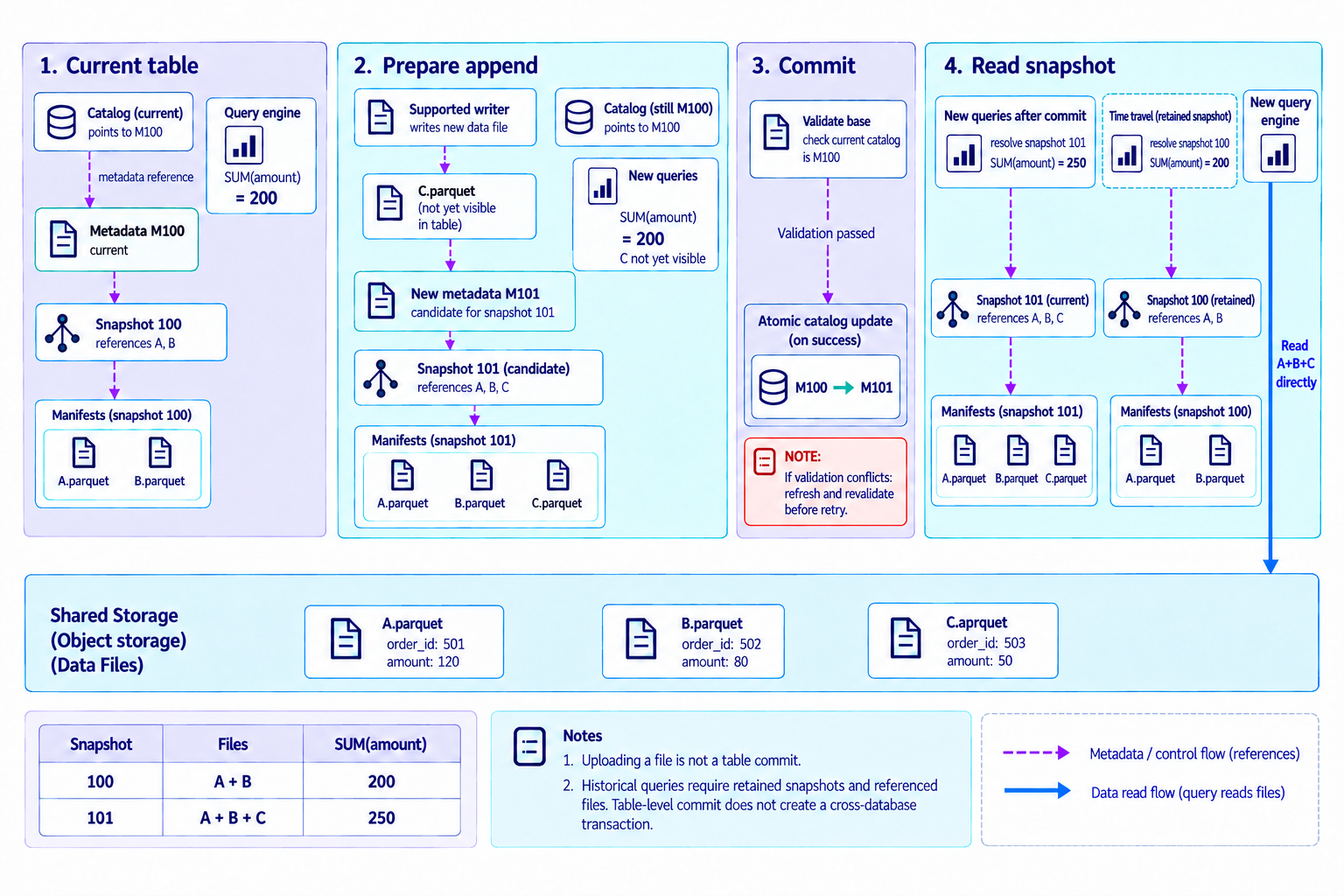
Uploading a file is not a table commit. Time travel requires retained snapshots and their referenced files. A table-level commit does not establish a distributed transaction across external databases.
Read the official documentationConnect data changes, historical queries and maintenance to business requirements.
| Capability | Practical value |
|---|---|
| Table-level transactions | Keep uncommitted changes out of current table queries and read data using the selected snapshot. |
| Time travel | Reproduce analysis using retained historical snapshots and compare states before and after changes. |
| Schema and partition evolution | Adapt supported column and partition definitions as data and query patterns change. This does not automatically reorganize every existing file. |
| File pruning | Use partition and column statistics to reduce files read. Results depend on layout, statistics and queries. |
| Data changes | Apply INSERT, UPDATE, DELETE and MERGE through supported engines. Design CDC capture, deduplication and change ordering separately. |
| Table maintenance | Compact small files, expire snapshots and remove unreferenced files while accounting for active jobs and historical retention. |
Check engine, connector, Iceberg table-version and catalog support. Validate concurrent engine use and write compatibility in the target deployment.
Starburst Iceberg reads, writes and maintenance documentationBuild history in your lakehouse and connect directly to operational data when needed.
Collect database, file and API data into Iceberg tables for historical analytics and reuse.
Connect multiple sources through Starburst SQL and JOINs without requiring a complete copy first.
Data Dynamics combines architecture, installation, integration, validation, performance measurement and operating procedures.
Combine ingestion into the lakehouse with direct, federated access to existing sources.
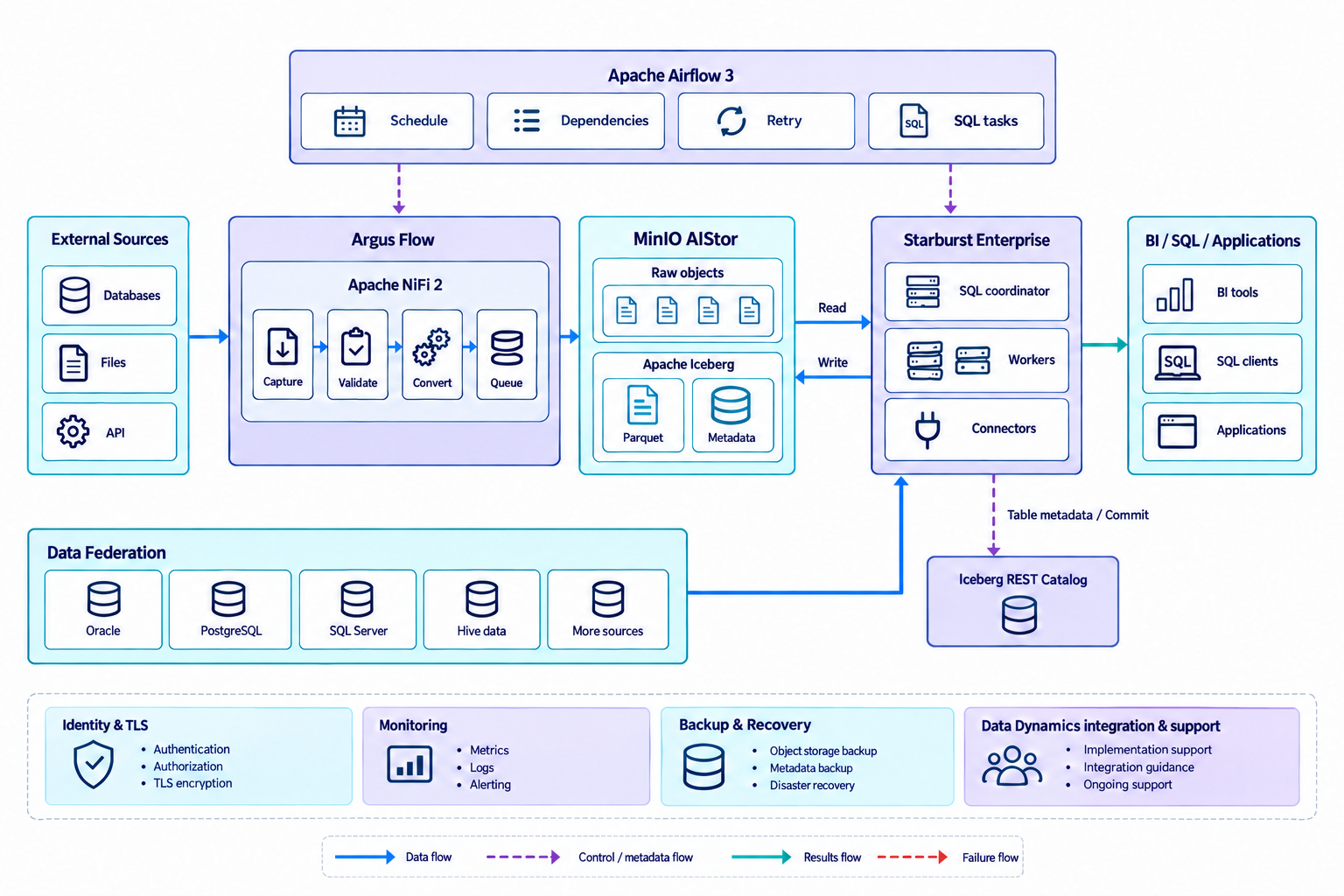
Iceberg is the table format and MinIO AIStor is the storage layer. The REST catalog is a reference configuration; implementation, versions, authentication and write paths are validated together.
Read the official documentationConnect the products through data flows and operational practices designed for your business.
| Component | Responsibility |
|---|---|
| Argus Flow · Apache NiFi 2 | Ingestion, CDC, transformation, delivery, queues and replay through processors and controller services. |
| Apache Airflow 3 | Schedules, dependencies and orchestration of downstream SQL, quality checks and table maintenance. |
| Starburst Enterprise | Data federation across databases, cross-source JOINs, Iceberg reads and writes, and distributed SQL. |
| MinIO AIStor | S3-compatible storage for raw objects, Parquet and Iceberg metadata, with commercial subscription and support. |
| Apache Iceberg · REST catalog | Snapshots and table metadata. Catalog implementation, authentication and write compatibility are validated during delivery. |
Design connections across Oracle, Hive and Impala environments, plus many other data sources.
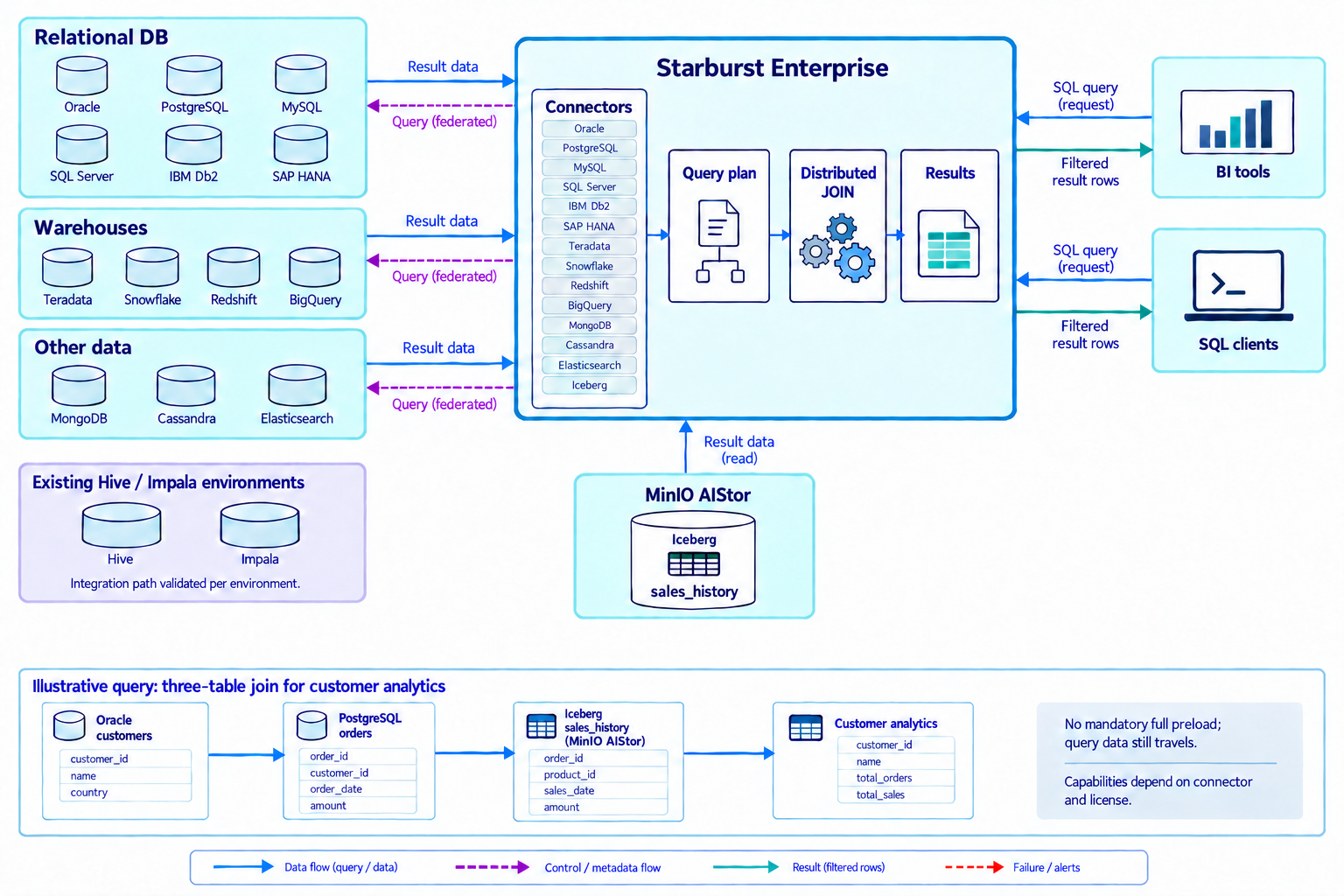
Federation reduces the need for full central preloading. Query execution still transfers data, and source load and access permissions must be managed.
Read the official documentationBring operational databases, existing analytics platforms, cloud warehouses and your lakehouse into a common SQL access path.
| Source category | Example sources |
|---|---|
| Relational databases | Oracle · PostgreSQL · MySQL · SQL Server · IBM Db2 · SAP HANA |
| Data warehouses | Teradata · Snowflake · Amazon Redshift · Google BigQuery |
| NoSQL & search | MongoDB · Cassandra · Elasticsearch |
| Existing big data platforms | Hive · Impala environments — integration depends on existing tables, storage and access methods |
| Platform lakehouse | Apache Iceberg tables stored on MinIO AIStor |
Features, authentication and licensing vary by connector. A dedicated, supported Impala connector is not assumed: data access and compatibility are validated for the existing environment. Generic JDBC is evaluated for PoC use with production support assessed separately.
Starburst connector supportSee how processor-level data handling connects to the order of downstream tasks.
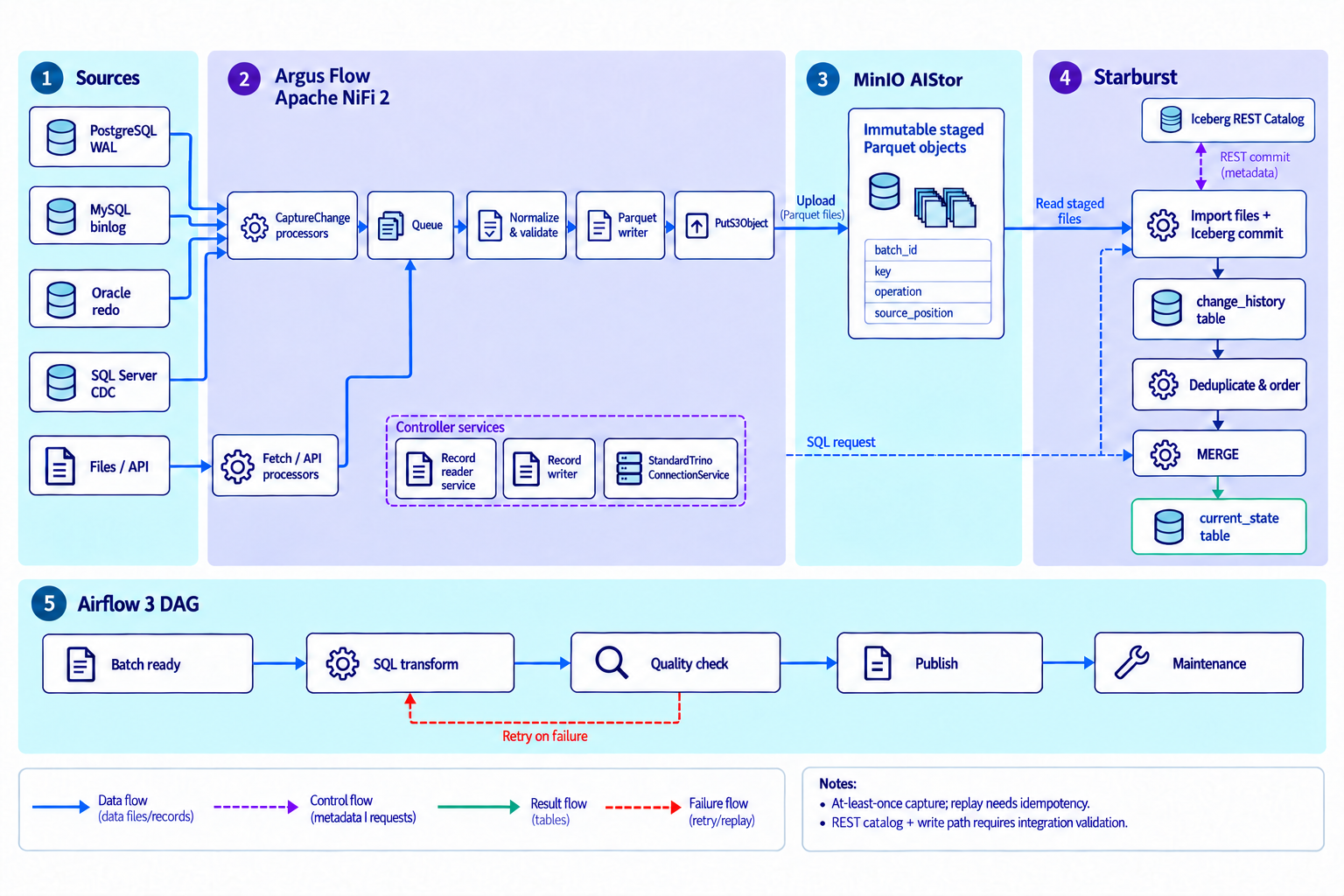
The reference path combines Argus Flow S3 uploads with Starburst file import. add_files does not validate schemas: configure schema/partition checks, duplicate-import prevention and retention for registered files. Direct REST-catalog writes through NiFi PutIceberg are not assumed.
Read the official documentationEnterprise storage delivered with a commercial subscription and technical support.
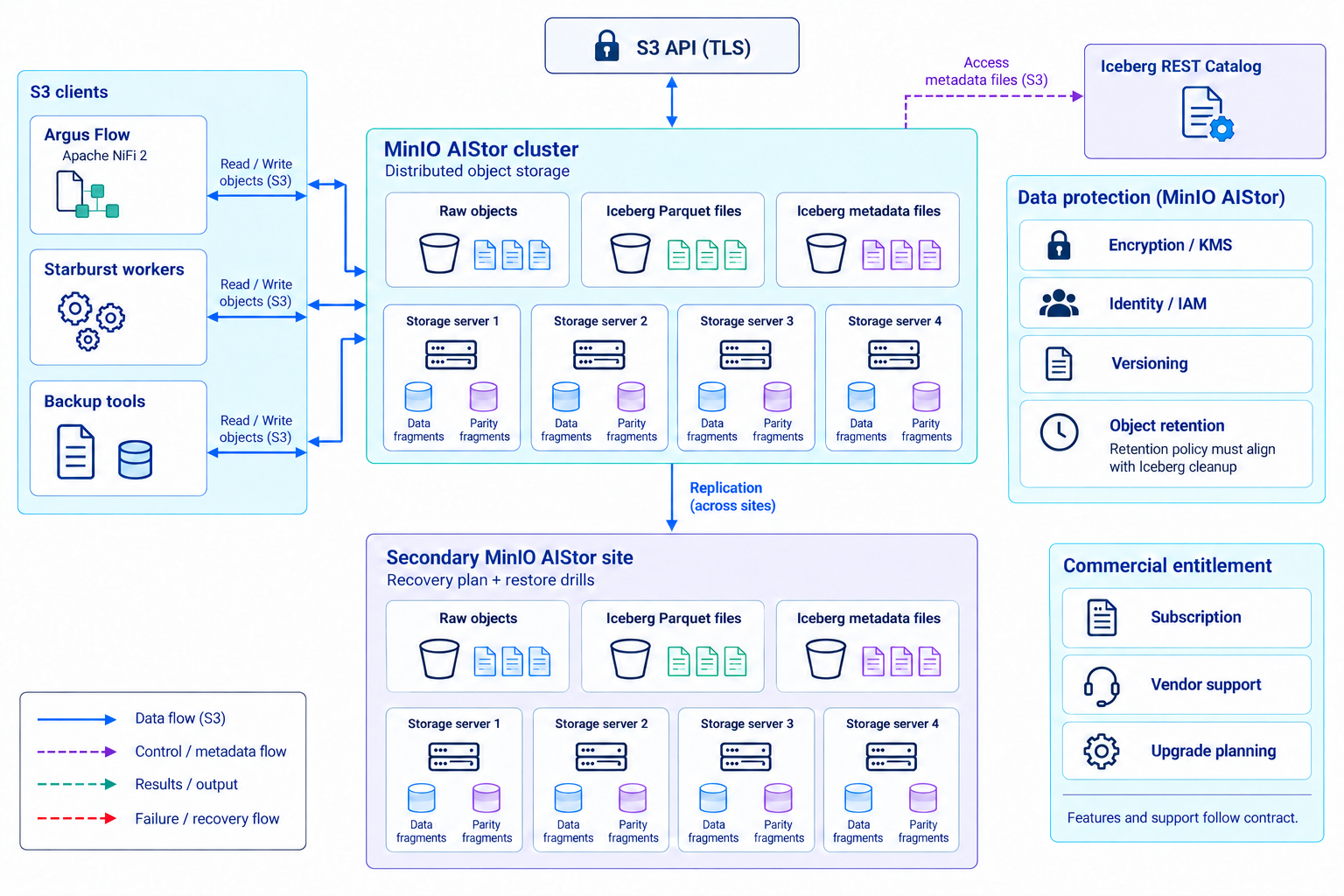
Entitlements follow the contracted product; object retention and locking must align with Iceberg cleanup and snapshot expiration.
Read the official documentationDistinguish database pushdown from Iceberg scan optimization.
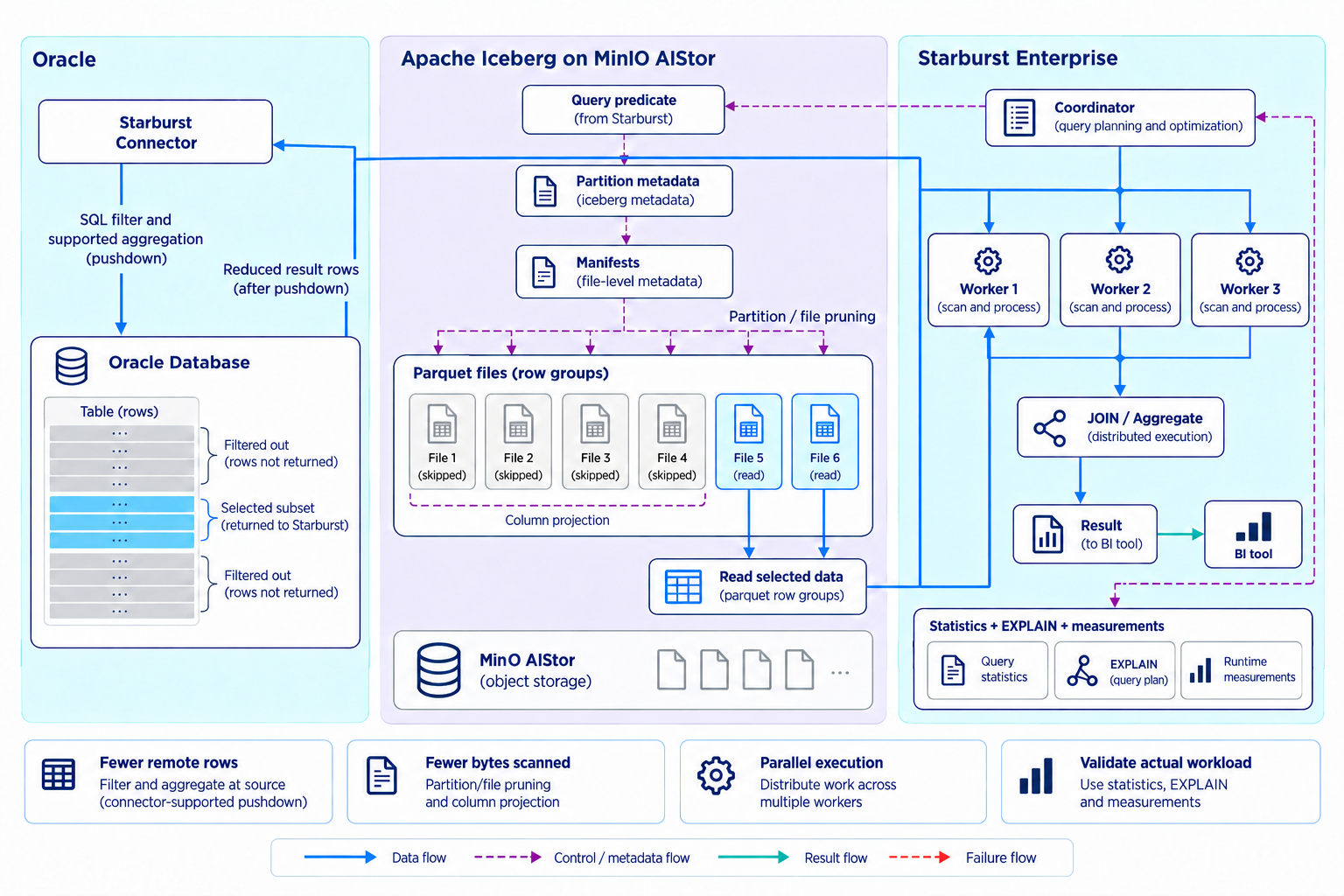
Pushdown depends on the connector and query. MinIO AIStor does not execute SQL. Validate plans and measured performance against data distribution, statistics, network and concurrency.
Read the official documentationObserve pipelines, queries and storage; make recovery and table maintenance repeatable.
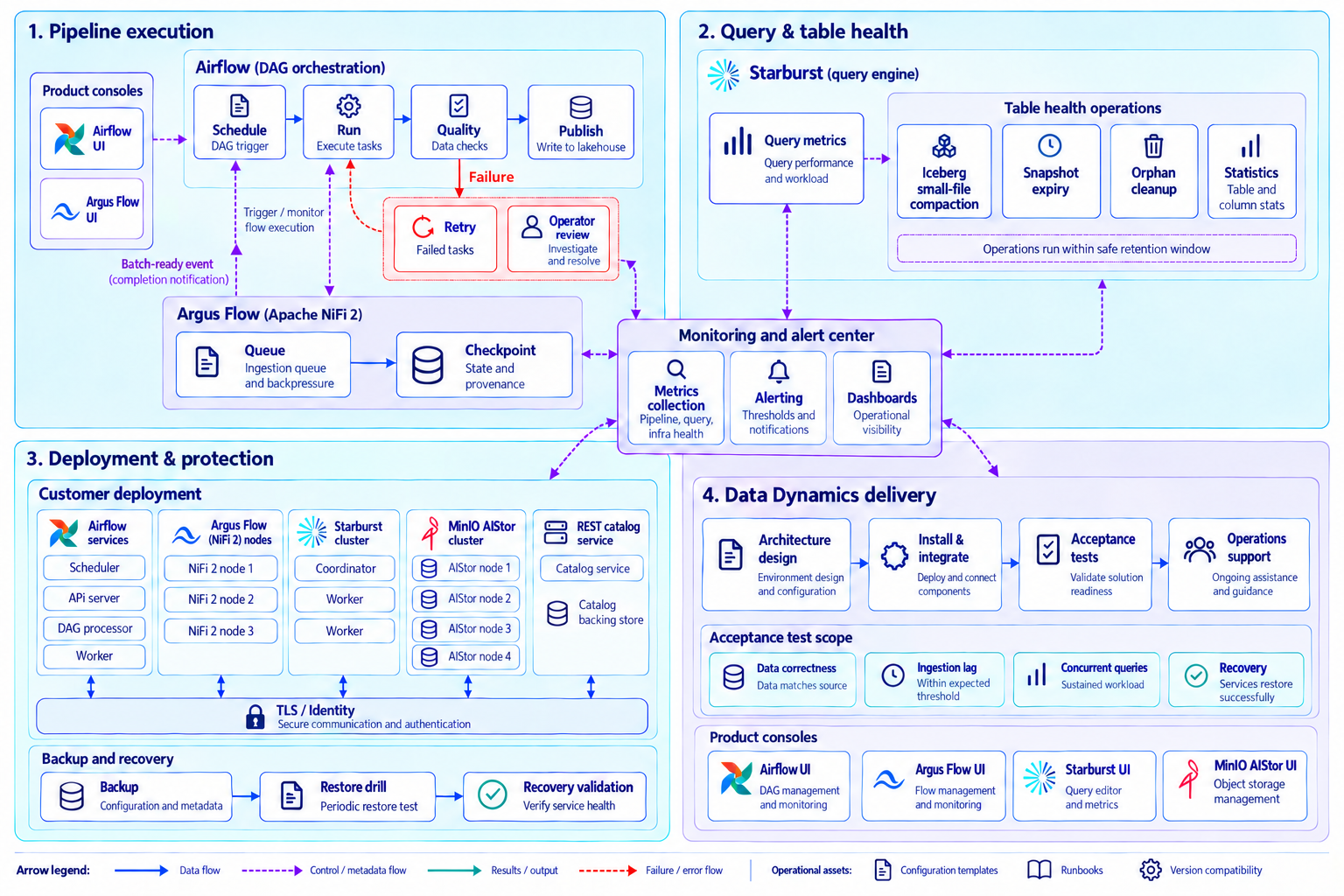
Apply retries to idempotent tasks. Snapshot expiration and orphan cleanup must respect active jobs and retention windows. Validate recovery objectives with restore exercises.
Read the official documentationData flows, acceptance criteria and operating procedures accompany the deployment. Delivery scope and support terms are defined in the agreement.
Validate ingestion, federation and Iceberg integration with representative data and queries; define capacity, concurrency, security and recovery requirements.
Configure version combinations, templates, NiFi flows, Airflow DAGs, catalogs, authentication, dashboards, alerts and runbooks.
Coordinate incident response and vendor support, upgrade compatibility, performance reviews and backup/restore exercises.
This is an integrated deployment and operations package using product-specific consoles. MinIO AIStor and Starburst products, licenses and support scope are confirmed in the proposal and agreement.
Explore component capabilities and extension options.