
Argus Catalog
An integrated AI·Data·API metadata platform that governs data, models, APIs, and AI agents in a single catalog. With strong support for air-gapped and on-premises environments, it secures enterprise-wide data sovereignty without ever sending data outside.
One catalog for data, models, APIs and agents
Register assets, connect their metadata and relationships, then discover, govern and use them.
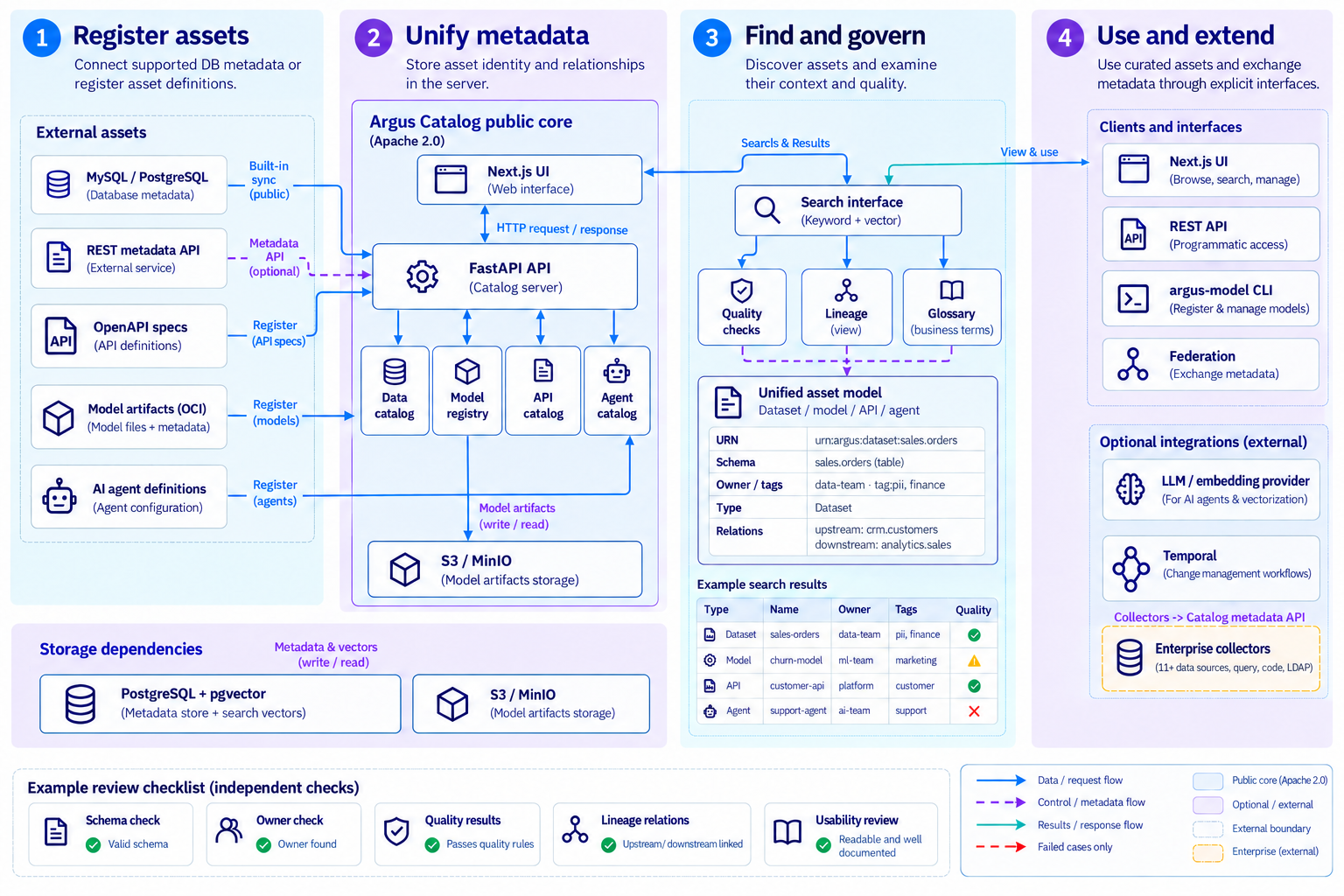
- 1.Register assets
- Use supported DB synchronization or REST APIs to register datasets, models, APIs and agents.
- 2.Unify metadata
- Connect asset identifiers, schemas, owners and tags to their business context.
- 3.Discover and govern
- Combine keyword and vector search with quality, lineage and glossary information.
- 4.Use and extend
- Access assets through the UI, REST APIs and model CLI, and exchange metadata through federation.
PostgreSQL stores metadata; S3/MinIO stores model artifacts. The 11-source collection extensions belong to the Enterprise area, separate from built-in DB synchronization.
View GitHub documentation and codeFrom source metadata to trusted asset context
Enrich synchronized DB metadata with ownership and business meaning, then inspect quality and lineage before use.
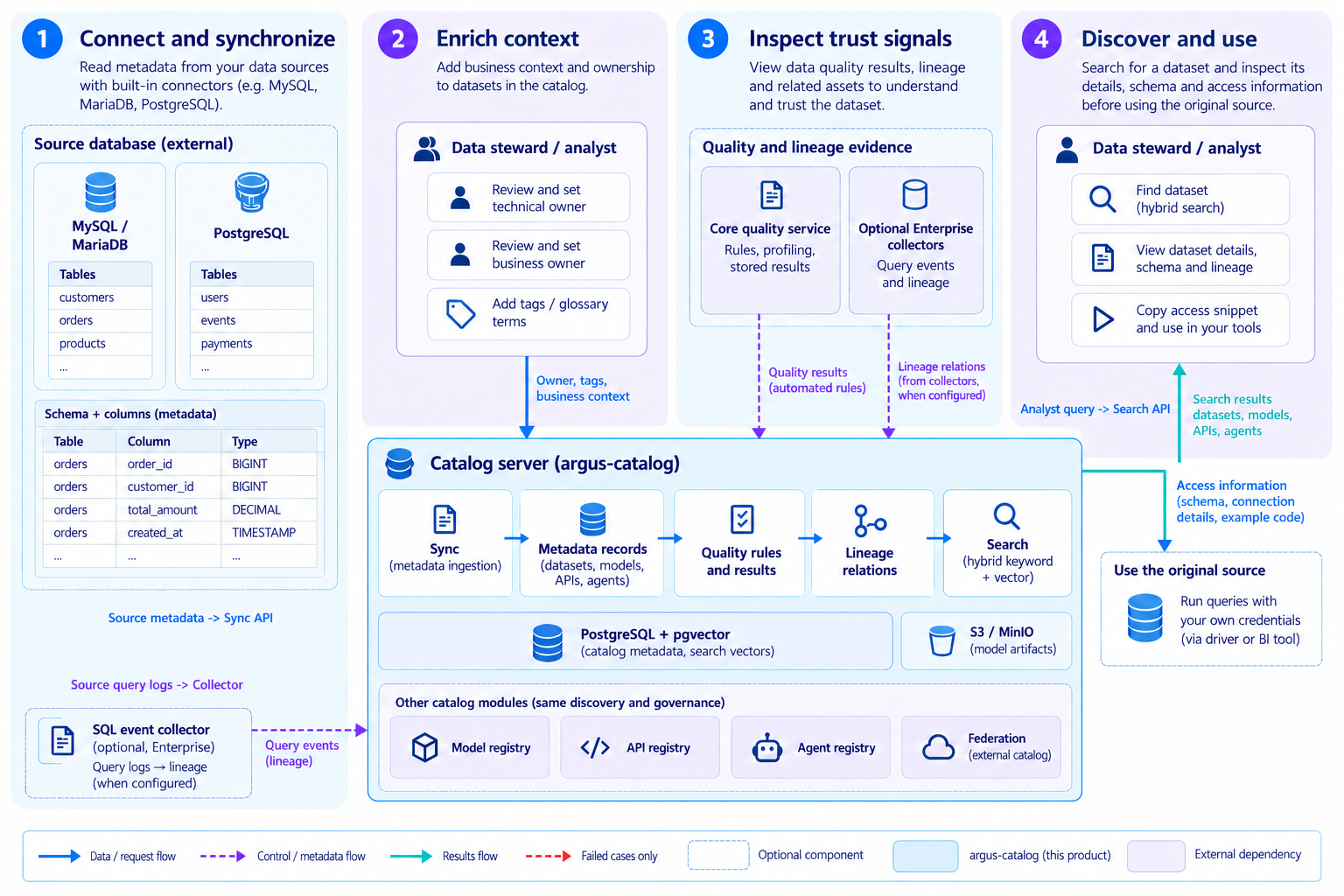
- 1.Connect and synchronize
- Read table and column metadata from a source DB into the catalog.
- 2.Enrich business context
- Associate technical and business owners, tags and glossary terms.
- 3.Inspect trust signals
- Review quality rule results, scores and registered lineage relationships.
- 4.Discover and use
- Find the dataset and review its schema and access details before using the source system.
This example uses built-in MySQL/MariaDB and PostgreSQL synchronization. Automatic SQL lineage collection requires separately configured collectors.
View GitHub documentation and codeExplore the complete catalog toolkit
Data quality, asset registries, AI assistance and federation work around shared metadata.
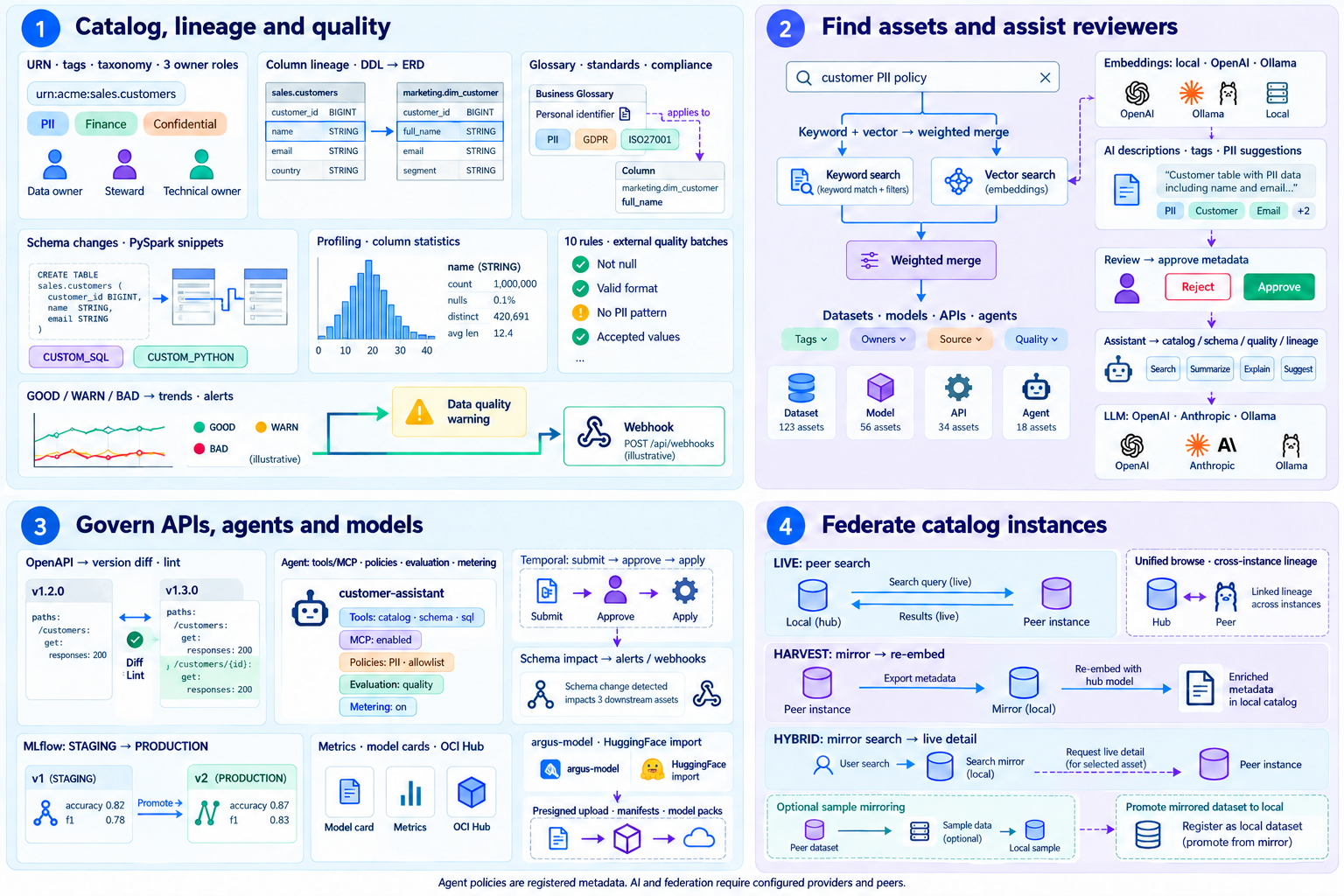
- 1.Data trust
- Inspect schema, owners, lineage, standards and rule-based quality.
- 2.Discovery and AI
- Search four asset types and review generated metadata.
- 3.Asset governance
- Manage API, agent and model definitions and their versions.
- 4.Federation
- Choose live queries, harvested mirrors or hybrid detail access.
Agent policies are registered metadata. AI and federation require configured providers and peers.
View GitHub documentation and codeChoose core software and extension services
Community includes the public core; Enterprise adds the listed extensions and dedicated services.
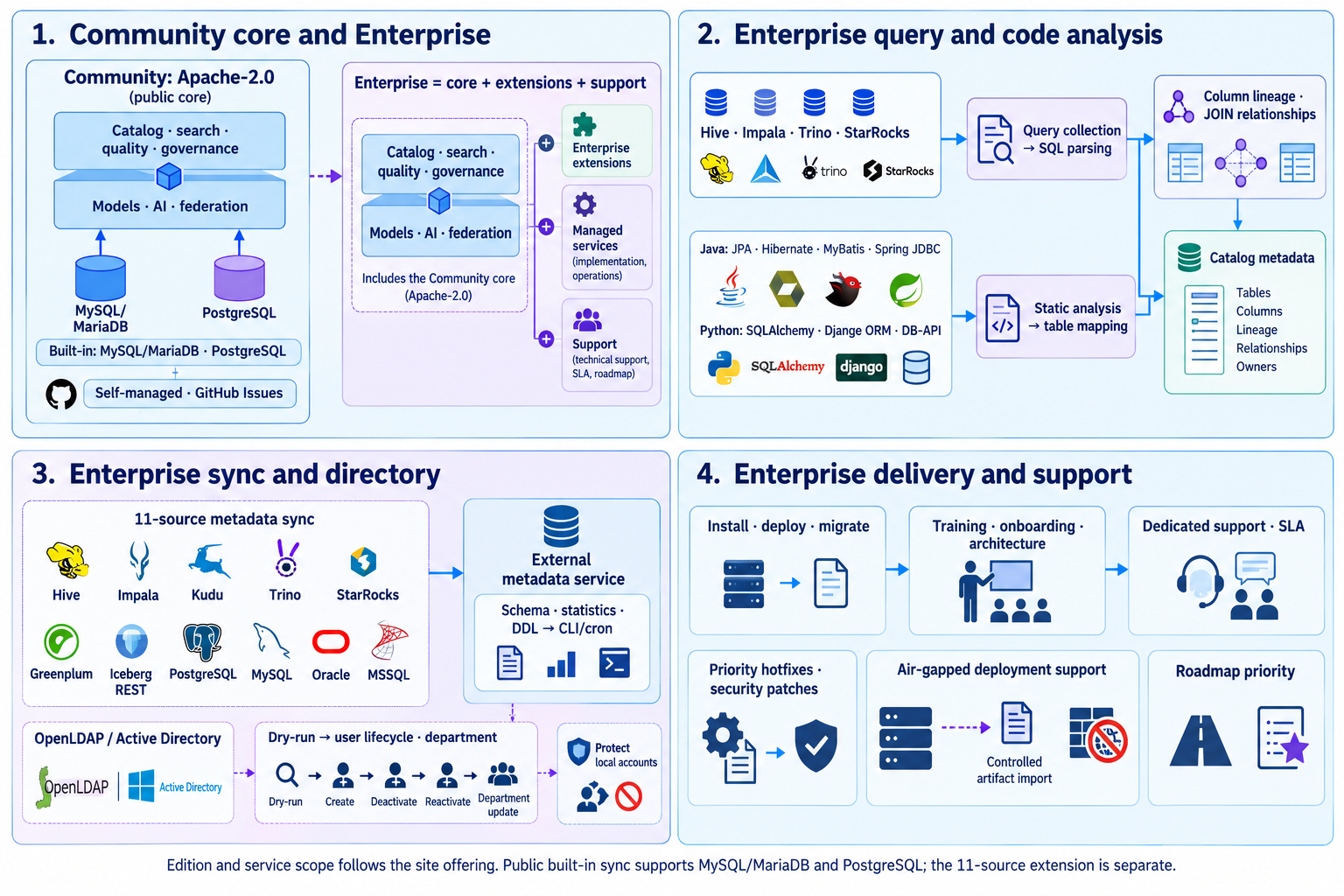
- 1.Shared core
- Core catalog, AI and federation are available in both editions.
- 2.Analysis extensions
- Enterprise adds query collectors and Java/Python static analysis.
- 3.Sync extensions
- Extended metadata connectors and LDAP/AD synchronization are Enterprise modules.
- 4.Dedicated services
- Enterprise services cover deployment, migration, training and support.
Edition and service scope follows the site offering. Public built-in sync supports MySQL/MariaDB and PostgreSQL; the 11-source extension is separate.
View GitHub documentation and codeAn open-source metadata platform
Argus Catalog is fully open-sourced on GitHub under the Apache License 2.0. Apart from the metadata ingestion connectors, the entire core engine — backend, frontend, SDK, AI agent, and quality batch — is public, so enterprises can verify the code directly, extend it to fit their environment, and operate it without any external data leakage.
- Apache 2.0 with no commercial-use restrictions
- Verify and extend the code yourself
- Self-host in air-gapped / on-premises